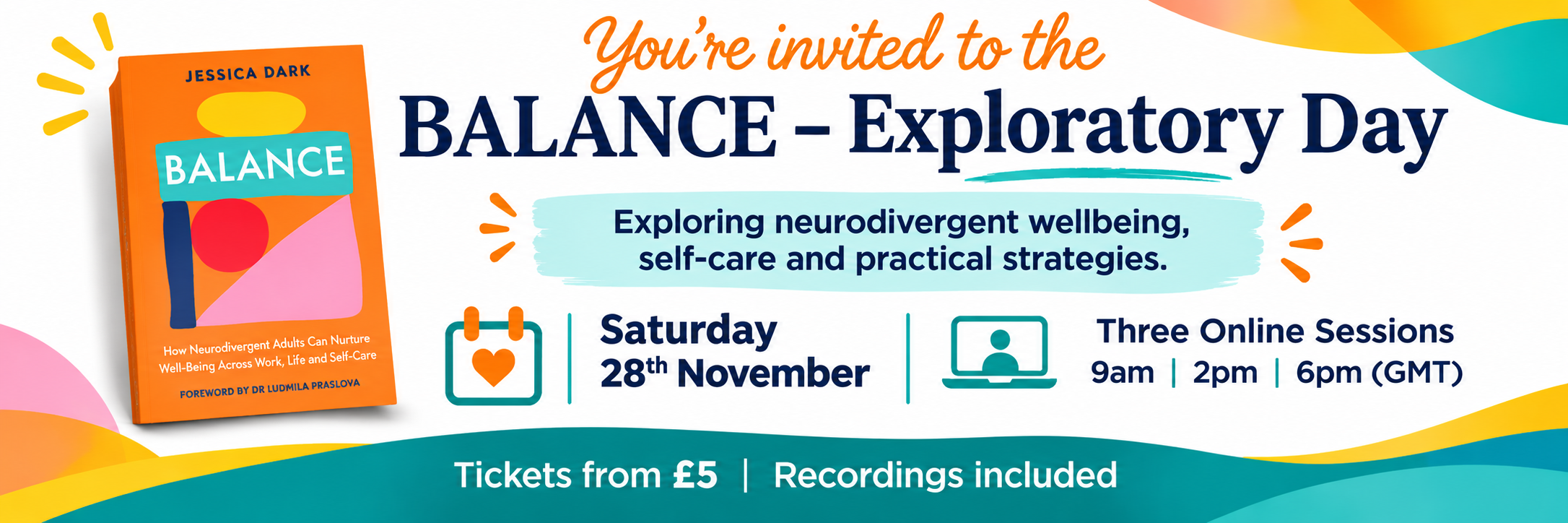
Saturday 28 November 2026 | Three Online Sessions | Tickets from £5
What is the point of chasing your dream job if, by the end of each day, you are completely drained and unable to move?
This was a question I found myself returning to while working towards my PhD, initially exploring autistic women's experiences of diagnosis disclosure in the workplace. At the time, I was navigating my own health challenges while reflecting on the experiences shared by women participating in my research.
Many were achieving professional success, yet struggling to sustain it. Some encountered discrimination, while others devoted so much energy to their working lives that little remained for themselves.
These experiences resonated with my own and raised important questions about how we understand and support neurodivergent wellbeing.
For many of us, balancing work, home life and personal wellbeing can be challenging. We may grow up without understanding our neuro-cognitive characteristics or how to support ourselves. Even when support is available, it may not reflect our individual needs or circumstances.
I began to question whether we needed to change how we approach wellbeing, rather than continually expecting neurodivergent people to adapt.
Amid my academic writing, I felt drawn to write something different.
The result was BALANCE: How Neurodivergent Adults Can Nurture Well-Being Across Work, Life and Self-Care, published by Jessica Kingsley Publishers on 19 November 2026, with a foreword by Dr Ludmila Praslova.
I wrote BALANCE for our neurodivergent communities, but also for the person I was before I had the language and tools to understand my own neurodivergence.
I certainly don't consider myself a self-care guru! Self-care has often been something I've struggled with, which is precisely why I wanted to explore it.
Through psychology, research, community experiences and personal reflection, BALANCE challenges conventional ideas about work-life balance and considers how we can develop approaches to wellbeing that recognise our individual characteristics, environments and changing needs.
Rather than treating balance as equal time between work and home, the book takes a whole-life approach, recognising the interconnected relationships between work, life and personal self-care.
A Book Launch with a Difference:
When I started thinking about launching BALANCE, I knew I wanted to do something a little different.
Rather than organising a traditional book launch focused primarily on celebrating its publication, I wanted to create an opportunity for people to explore the ideas behind it, ask questions and consider how they might apply to their own experiences.
And so, the BALANCE Exploratory Day was born!
Taking place online on Saturday 28 November 2026, the day brings together three one-hour sessions exploring the theoretical foundations of BALANCE, neurodivergent self-care and regulation, and practical strategies for supporting wellbeing.
Three Sessions Across the Day:
9:00 - 10:00 AM GMT — Balance and Neuro-Cognitive Trait Interaction
Our first session introduces the Neuro-Cognitive Trait Interaction Model (NCTIM), which underpins BALANCE, and explores how our neuro-cognitive characteristics interact with environmental demands and opportunities.
We will also look at the book's structure, reflective activities and practical tools, including different ways to engage with them.
2:00 - 3:00 PM GMT — Neurodivergent Self-Care and Regulation
Self-care is often associated with familiar recommendations such as meditation, exercise, relaxation and maintaining routines. But what happens when these approaches don't reflect our needs?
This session considers how sensory experiences, attention, energy, and environmental demands shape self-care and regulation, and explores approaches that accommodate individual differences.
6:00 - 7:00 PM GMT — Putting Balance Strategies into Practice
Our final session focuses on translating the ideas within BALANCE into practical strategies, exploring the book's activities and toolkit guidance, and considering how to adapt them to different circumstances.
I'll also share a sneak peek at Palm & Palm Alternative Meditation, offering a different way to find calm through music, movement, reflection, and self-care.
Each session includes opportunities for questions, answers and discussion.
Join in Your Own Way:
I've designed the Exploratory Day to offer flexibility, recognising that attending online events can involve different demands.
You are welcome to attend one, two or all three sessions, listen without contributing to discussions or catch up afterwards through the recordings.
Recordings will be available to all attendees, with the aim of sharing them within 48 hours of the final session. They may be edited to protect attendees' privacy, particularly where personal contributions feature during discussions.
You don't need to have read BALANCE or have previous knowledge of NCTIM to participate.
The day is open to neurodivergent adults, family members, practitioners, researchers, professionals and anyone interested in exploring neurodivergent wellbeing.
I'm looking forward to sharing BALANCE, exploring its ideas and hearing your thoughts and questions. I hope the day provides an opportunity to challenge assumptions about wellbeing and consider how we can create more responsive approaches to supporting neurodivergent people.
Let's reimagine inclusion together,
Jess x x