Language shapes how people understand themselves, communicate experiences and connect with others. For autistic people, the words used to describe experiences also influence how autism is understood across research, healthcare, education and wider society. Historically, much of this language has emerged from medical and clinical perspectives, often focusing on observable behaviours, difficulties and diagnostic characteristics. While clinical knowledge has an important role, it does not always reflect how autistic people experience, interpret or understand the world.
Within autistic communities, people have developed and shared language that offers different perspectives on sensory, cognitive, emotional and relational experiences. These terms can help articulate experiences that may previously have been misunderstood, overlooked or difficult to explain. Research exploring terminology preferences has also identified differences between the language preferred by autistic adults and that used by professionals (Kenny et al., 2016). This raises important questions about whose language describes autistic experiences and how those choices shape understanding.
Listening to our autistic communities means recognising autistic people as contributors to knowledge, language, and cultural understanding, rather than simply a community to observe and interpret.
Understanding Autism Beyond Clinical Language
Clinical terminology and community-informed language can describe similar experiences while emphasising different aspects of their meaning. For example, autistic communities widely use stimming to describe repetitive movements, sounds or sensory activities that can support emotional regulation, sensory management and communication. While clinical literature may describe similar behaviours as motor stereotypies or repetitive behaviours, research exploring autistic adults' perspectives highlights the importance of understanding their function and meaning for support and understanding (Kapp et al., 2019).
Similarly, masking describes how autistic people may consciously or unconsciously modify or suppress autistic characteristics in response to social expectations. Hull et al. (2017) explored social camouflaging among autistic adults, identifying motivations such as fitting in, developing relationships and avoiding negative social responses. Monotropism, developed by Murray, Lesser and Lawson (2005), offers an attention-based account of autism that considers how attention may become concentrated in particular interests or activities, providing an alternative perspective on experiences often described as restricted interests or difficulty shifting attention.
These distinctions matter because language shapes how experiences are interpreted, including whether they are understood as meaningful, problematic, adaptive or requiring support. When clinical terminology is used without considering the language and meanings expressed by autistic people, important nuances can be lost, potentially contributing to misinterpretation. For professionals and researchers, this highlights the importance of seeking clarification when community language or its intended meaning is unfamiliar, rather than making assumptions. It also means recognising and incorporating community-informed terminology into research, academic literature and professional discussions about autistic people, while respecting individual language preferences.
Understanding the nuances of language is essential to accurately representing autistic experiences and to ensuring that community knowledge informs how autism is understood.
Community Language, Identity and Belonging
The importance of community language extends beyond description. Shared concepts can help people recognise experiences, communicate needs and develop a sense of connection and belonging. As an adult-recognised autistic woman, some of the most meaningful insights into my own experiences have emerged through autistic communities. Finding language that reflects experiences I had previously struggled to explain has helped me understand myself better and recognise connections with others.
One concept that has influenced my thinking is access intimacy, introduced by disability justice activist Mia Mingus (2011). Access intimacy describes the experience of having access needs understood and recognised without repeatedly explaining or justifying them. Although developed within broader disability justice activism, the concept offers valuable insights into the importance of recognition, responsiveness and relational understanding. Another concept I use is neuro-kinship, which describes a sense of connection, familiarity and mutual understanding that can emerge through shared or compatible neurodivergent experiences. This might involve recognising similar ways of processing information, finding communication easier or experiencing understanding without extensive explanation. For me, neuro-kinship captures an important relational dimension of neurodivergent experiences, particularly the recognition and belonging that can emerge within community spaces. These concepts illustrate how language can communicate aspects of experience that established clinical terminology may not adequately capture. However, community language is neither fixed nor universally shared. Autistic people have diverse experiences, identities and preferences, and not everyone identifies with the same concepts.
Understanding community expression, therefore, requires curiosity about the meanings people attach to language, while recognising that no single term or perspective can represent everyone.
Celebrating Autistic Community Language: A Resource for Learning
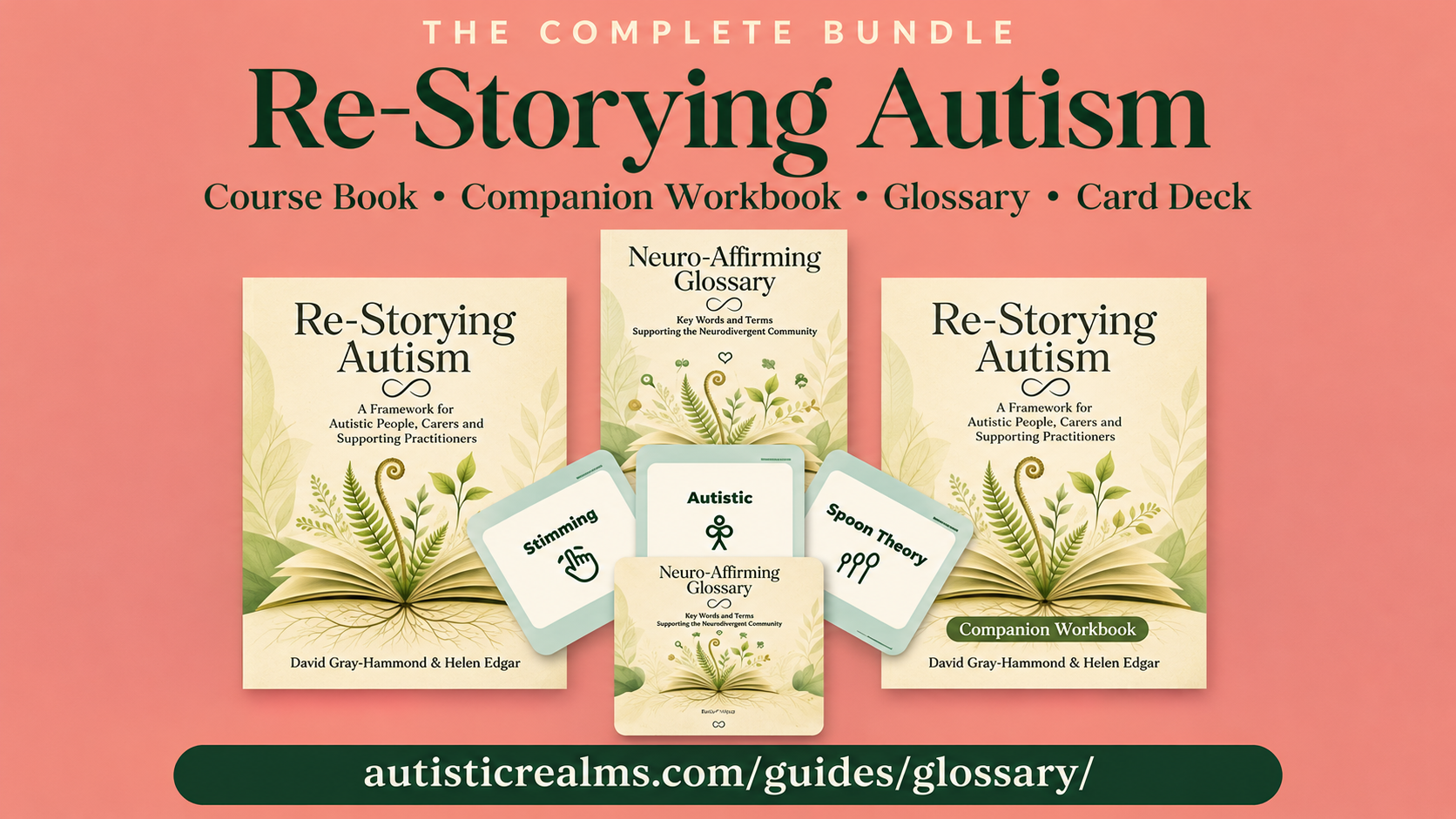
An example of work that supports greater recognition and understanding of autistic community language is the Neuro-Affirming Glossary of Key Words and Terms, developed by Helen Edgar, founder of Autistic Realms, and David Grey-Hammond, founder of Neurokindred (Edgar & Grey-Hammond, 2026). Drawing on lived experience, professional practice and engagement with neurodivergent communities, Helen has developed a resource that brings greater visibility to the language and concepts used within autistic and wider neurodivergent communities. The 2026 edition includes 222 terms, with accessible explanations, references and acknowledgements of documented origins, while recognising that language continues to evolve and community perspectives are diverse.
I particularly value resources such as the Neuro-Affirming Glossary, because they create opportunities for practitioners and researchers to engage more meaningfully with autistic community expression. Understanding community-informed language can encourage reflection on how experiences are interpreted, how professional terminology is used and whether established descriptions adequately reflect autistic perspectives. Within research, this understanding can inform recruitment materials, interview questions, analysis and dissemination. Across professional practice, it can support more informed conversations, greater recognition of individual experiences and critical reflection on assumptions that may influence how people are understood and supported.
Importantly, the glossary offers a starting point for learning rather than a definitive account of autistic experiences. Becoming familiar with terminology does not necessarily mean understanding the experiences behind it, and community knowledge continues to develop through dialogue, reflection and shared experiences. Helen's work offers an accessible way to explore this knowledge while encouraging professionals to consider how language shapes understanding and practice.
The glossary is freely available online, alongside guidance for exploring and applying the resource, through Autistic Realms.
From Listening to Understanding: Working Towards Epistemic Justice
Recognising autistic community knowledge is closely connected to epistemic justice, which concerns fairness in how knowledge is recognised, interpreted and valued (Fricker, 2007). Historically, autistic experiences have often been understood through professional and clinical perspectives, sometimes overlooking the knowledge of autistic people themselves. Community-developed language can help address these gaps by providing concepts that better reflect lived experiences. However, meaningful understanding requires more than adopting terminology; it involves recognising the value of autistic perspectives and questioning assumptions that influence how experiences are interpreted. Milton's (2012) double empathy problem further highlights how differences in experiences and perspectives can contribute to mutual difficulties in understanding between autistic and non-autistic people.
These considerations informed my development of Autistic Community Alignment (Dark, 2026), introduced in my chapter in The Palgrave Handbook of Neuroinclusive Social Work. The framework emphasises recognising autistic ways of knowing, developing respectful relationships and affirming autistic identity through culturally meaningful language and practices. Although developed within research, these considerations have wider relevance for healthcare, education, employment and other settings where community knowledge can inform more responsive and inclusive approaches.
Working towards epistemic justice requires continued engagement with autistic communities, recognising diverse experiences and remaining open to perspectives that challenge established understanding. Resources such as Helen Edgar's glossary can support this learning, but their value ultimately lies in how that knowledge influences professional thinking and practice.
Listening to the autistic community is not simply about choosing different words, but about recognising the knowledge and experiences behind those words and allowing that understanding to inform more inclusive research, professional practice and wider society.
I hope that by continuing conversations about how autism and autistic people are understood, and reflecting on how autistic people are treated and supported, we can gradually contribute to a more compassionate, accepting and supportive understanding of difference. Recognising and valuing different experiences and perspectives is an important part of creating a society where people feel understood, respected and included.
Have you ever felt that your experiences or explanations have been misunderstood or misinterpreted by others? I would love to hear your thoughts, so please leave a comment and keep the conversation going.
Let’s reimagine inclusion together,
Jess xx
References:
Dark, J. (2026). Creating an inclusive and relationally attuned research space for neurodivergent participants. In H. Bertilsdotter-Rosqvist, L. Deacon, & J. Guthrie (Eds.), The Palgrave handbook of neuroinclusive social work (pp. 535–556). Palgrave Macmillan. https://doi.org/10.1007/978-3-032-18034-6_23
Edgar, H. (2026). Neuro-affirming glossary of key words and terms (2026 ed.). Autistic Realms. https://autisticrealms.com/guides/glossary/
Fricker, M. (2007). Epistemic injustice: Power and the ethics of knowing. Oxford University Press. https://doi.org/10.1093/acprof:oso/9780198237907.001.0001
Hull, L., Petrides, K. V., Allison, C., Smith, P., Baron-Cohen, S., Lai, M.-C., & Mandy, W. (2017). “Putting on my best normal”: Social camouflaging in adults with autism spectrum conditions. Journal of Autism and Developmental Disorders, 47, 2519–2534. https://doi.org/10.1007/s10803-017-3166-5
Kapp, S. K., Steward, R., Crane, L., Elliott, D., Elphick, C., Pellicano, E., & Russell, G. (2019). ‘People should be allowed to do what they like’: Autistic adults’ views and experiences of stimming. Autism, 23(7), 1782–1792. https://doi.org/10.1177/1362361319829628
Kenny, L., Hattersley, C., Molins, B., Buckley, C., Povey, C., & Pellicano, E. (2016). Which terms should be used to describe autism? Perspectives from the UK autism community. Autism, 20(4), 442–462. https://doi.org/10.1177/1362361315588200
Milton, D. E. M. (2012). On the ontological status of autism: The ‘double empathy problem’. Disability & Society, 27(6), 883–887. https://doi.org/10.1080/09687599.2012.710008
Mingus, M. (2011, May 5). Access intimacy: The missing link. Leaving Evidence. https://leavingevidence.wordpress.com/2011/05/05/access-intimacy-the-missing-link/
Murray, D., Lesser, M., & Lawson, W. (2005). Attention, monotropism and the diagnostic criteria for autism. Autism, 9(2), 139–156. https://doi.org/10.1177/1362361305051398